Material Author-Bredahl Krebs
If you're thinking about refractive surgery, you've likely come across LASIK, PRK, and SMILE. Each option has its own procedure and healing time, making them suited to different needs. Understanding the differences can help you make an enlightened choice. However just how do you determine which one straightens best with your way of living and vision goals? Allow's check out each option and uncover what may benefit you.
Recognizing LASIK: Procedure, Conveniences, and Recuperation
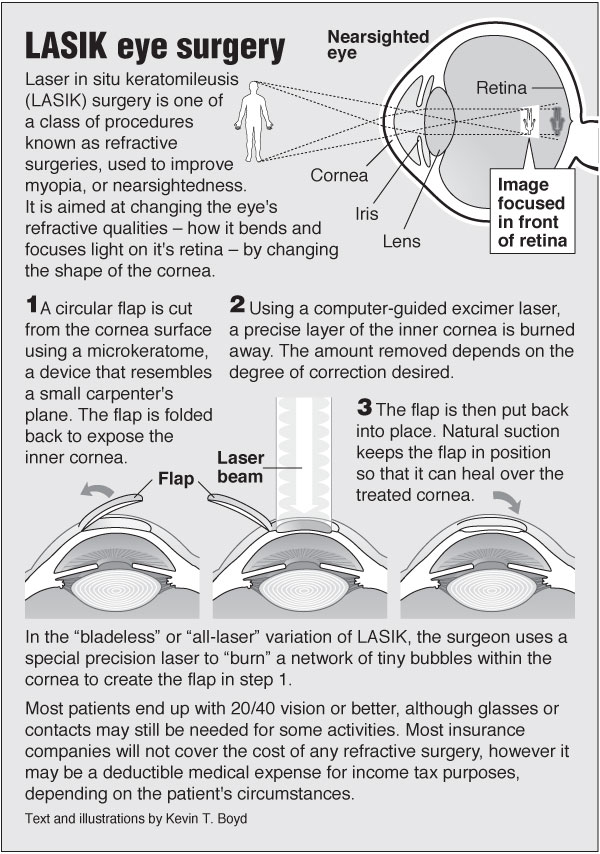
LASIK, a prominent refractive surgery, uses a life-altering service for those tired of glasses or calls. During https://www.healio.com/news/ophthalmology/20210512/refractive-lensectomy-challenges-laser-iridotomy-as-management-for-narrow-angles , your doctor utilizes a laser to reshape the cornea, allowing light to focus appropriately on your retina. It commonly takes about 15 mins per eye, and many people experience minimal discomfort.
You'll appreciate clearer vision virtually quickly, with lots of accomplishing 20/25 vision or better. The advantages of LASIK are enormous-- it decreases your dependancy on corrective lenses and improves your overall lifestyle.
Recovery is quick; you'll likely resume normal activities within a day, though it's necessary to follow post-operative treatment guidelines. With correct care, your boosted vision can last for many years, making LASIK a worthwhile financial investment in your view.
Exploring PRK: Just How It Works and What to Expect
If you're considering refractive surgical treatment, PRK (Photorefractive Keratectomy) is another superb alternative.
During the PRK treatment, your surgeon removes the external layer of the cornea to reshape the underlying cells using a laser. This procedure deals with nearsightedness, farsightedness, and astigmatism. Unlike LASIK, there's no corneal flap developed, making PRK ideal for those with thinner corneas.
After the surgical treatment, you'll need to take care of some discomfort and follow-up treatment as the surface layer heals. Vision enhancement normally happens slowly over a few days to weeks.
It's crucial to abide by your doctor's post-operative guidelines for optimal recuperation. In general, PRK supplies a safe and effective means to accomplish clearer vision, specifically for people that mightn't qualify for LASIK.
The SMILE Technique: Advantages and Factors to consider
One more cutting-edge alternative in the realm of refractive surgical procedure is the SMILE technique (Tiny Cut Lenticule Extraction). This minimally intrusive treatment entails developing a small cut to eliminate a lenticule of cells from your cornea, reshaping it to correct vision.
One major advantage of SMILE is its conservation of corneal stability, which may result in less dry eye contrasted to LASIK. You'll also experience a quicker recuperation time and very little discomfort.
Nonetheless, it's important to take into consideration that SMILE may not be suitable for everybody, particularly those with serious refractive errors or particular corneal conditions. Consulting with your eye treatment specialist can assist determine if SMILE straightens with your vision improvement goals and total eye health and wellness.
Conclusion
In choosing the right refractive surgical treatment for you, it's essential to evaluate the advantages and considerations of LASIK, PRK, and SMILE. Each alternative supplies unique advantages tailored to your individual demands, whether you prioritize fast recovery or have specific corneal conditions. By talking to your eye treatment professional, you can make an educated decision that ideal fits your vision goals and way of living. Keep in mind, the best choice can result in clearer vision and a much more fulfilling life.